Showing posts with label pope. Show all posts

Thursday, December 12, 2013

Answers to a "Pagan Christmas"

(posted previously at Ignitum Today)

Charlie gave Linus the pop quiz: what is Christmas all about? Of course, Linus proclaims the birth of Christ (was Linus named after the second Pope?)

Today it would have looked more like this:
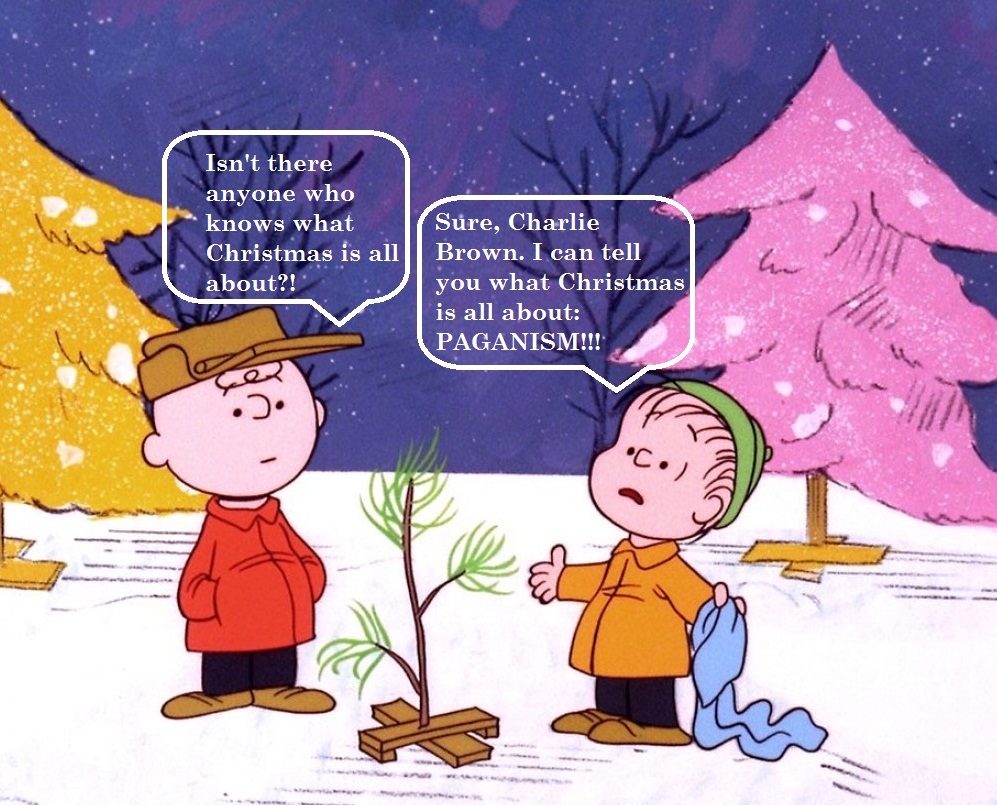
christmas-tree-charlie-brown-linus2

The modern Catholic, and most Christians for that matter, has many fronts to defend, one of them being the so-called “pagan roots.” This accusation is made on many facades of the faith. For example, an objector might tell you that Christians adopted the Holy Day of Easter from the pagan celebration of the fertility goddess, Ishtar (sounds a little like Easter, right?). This time of year though, you are likely to hear the objection that Christmas is a christo-pagan holiday, a mash-up of pagan belief and Christian celebration. Here are some of the objections or accusations you might meet, and a helpful way to respond.

1. Christians invented Christmas from the winter solstice celebration of Sol Invictus.

Yes, there were mid-winter celebrations in religions outside Christianity during the time of the Early Church. In fact, like Easter, the East and the West were observing Christmas differently, while until recently, the Armenians didn’t celebrate it at all. The West led the way with a distinctive nativity-based celebration, concluding with Holy Mass. That’s the same as how you see it today. The development of Christmas was not an assimilated celebration until the 4th century. Does that mean that the Apostle John, and Sts. Polycarp and Irenaeus, three men who were apostolically connected, did not celebrate Christmas? Probably so, but there is nothing wrong with this. Merely because a Christian celebration is similar to that of a pagan one proves nothing. There is either coincidence of the celebrations in the same time period or there is influence on one another.

The objector has to ask himself the following: 1) after centuries of persecution for not observing pagan holidays, where is the proof of influence? Or/and, 2) who influenced whom? Did Christianity have the influence on pagans to begin adopting a more public and concrete celebration or did we “Christianize” a pagan event? We can observe that the two were present at the time but neither scenario is a problem with the Christian because the Church has the ability to Christianize people and celebrations alike. Light was overcoming darkness at the celebration of Sol Invictus and in Christ, darkness was defeated by the real luminousness of Christ. Paganism had a hint, but Christianity had the answer.

2. The Christmas tree comes from pagan origins and is condemned in the Bible.
The objector can have a field day with this one. Evergreens are a near-universal symbol of hope in the winter season. They represent resurrection (triumph of live over death) for the Egyptians, everlasting life for the Scandinavians and Druids, and still, agricultural anticipation (to the god Saturnalia) for the Greeks/Romans. But the tree is not recognized as a use of Christmas celebration until the time of Luther. More closely connected to the ancient church is the use of evergreen wreaths. Your objector might say that it came around the same time as the popularity of the pagan celebration Saturnalia. Let him know that Tertullian wrote as early as A.D. 190-220, that Christians hang more “wreaths and laurels” than the pagans (who hang it for the “gate gods”) at their doors. He was condemning the wreath as something worth putting hope in like the pagans did with their temples, over that of Jesus who is the true Light in which we are the actual temples of the Spirit. He wasn’t condemning the décor! He ends with, “You are a light of the world, and a tree ever green.” READ TERTULLIAN “ON IDOLATRY“ HERE (see Chapter XV)
The passage in the Bible your objector is referring to comes from Jeremiah 10:3-4.
Thus says the LORD: Learn not the customs of the nations, and have no fear of the signs of the heavens, though the nations fear them. For the cult idols of the nations are nothing, wood cut from the forest, Wrought by craftsmen with the adze, adorned with silver and gold. With nails and hammers they are fastened, that they may not totter (NAB).
Let’s get one thing straight up front: Jeremiah was not talking about Christmas trees because he was writing hundreds of years before Christmas became a celebration. He was pointing out the idolatry of the people of that day, and much like Tertullian, was warning against the idolatry of those who put there hope in earthly gods and things.

Near to this, the objector must understand that Christians are not intent on worshiping their trees and are certainly not putting them in their living rooms and entryways to deter spirits. Perhaps for some carolers and eggnog, but not for protection.

Conclusion

There is nothing wrong with the Church “baptizing” certain practices of other religions. The objector is confusing the Church of deriving its beliefs from these celebrations, with the assimilation of seasonal celebrations and symbols. Like St. Patrick did with the clover to illuminate and demonstrate the reality of the Trinity. Akin to St. Paul explaining the “unknown god” at the Areopagus. Paul did not derive the idea from the Greeks that day, and Patrick did not derive the Trinity from a leaf.

We don’t believe that Christians hold the patent on Truth. Instead, we believe that God has riddled himself to other religions. In other words, just because a specific religion does not contain the whole truth, does not mean it contains no truth. If you witness to a pagan who believes a wreath will save him, maybe you can show him how Jesus is the fulfillment of that promise of everlasting life. Then, just as with the cross that hangs from our necks, we can display a wreath to remind us what is true. In this way, Christianity has the distinct ability to assimilate the “hints” of other religions.

Fr. Dwight Longenecker writes, “If a religion is not only true but more true than all the other religions, then it should connect with all those other religions at the points where they are true.” Read “Paganism, Prophecies, and Propaganda” HERE.

- See more at: http://www.ignitumtoday.com/2013/12/05/answers-to-a-pagan-christmas/#sthash.L3VDBdeW.dpuf

Monday, October 28, 2013

Book Review: Confessions of a Mega Church Pastor


I was visiting my local Catholic bookstore here in Omaha, Nebraska to look for some reading on a subject for one of my papers this semester. As I was checking out I found Confessions of a Mega Church Pastor by Allen Hunt and immediately recognized the Dynamic Catholic logo. It was reasonably priced so I added it to my purchase and went home.

What interested me about this book immediately is that I am a convert from the mega church scene as well. It is a topic I have written and blogged about before as well. In my conversion the problems in the mega church scene permeated my convictions and added to the need to find something different. I might have discovered reasons against baseline Protestantism, but the rising mega church scene added to my level of discomfort and disconnect in my faith at the time. You can ask my wife, I swore to the idea of finding a small church, even going so far as to provoke the thought of starting my own house-church. Well, it’s funny how things happen when you say “I will never” to God; I ended up joining the biggest Church there is – the Catholic Church.

That’s a story from another day but it fits well with this review. Adam Hunt is the former pastor of one of the largest Methodist congregations in the U.S. His story is inviting and personal, but also one of teaching and examination of the real treasures and genius found in the Catholic Church. Allen opens the book in an interesting way – he builds a picture, chapter by chapter, of a house. Each with different rooms and scenes, from the kitchen to the front porch, Allen takes the reader on a narrative journey through his conversion process. Throughout this house the narrative pastorally browses the challenges he faced personally and doctrinally while providing lively ways he was convinced of the Catholic faith. He tells of personal trial in details that only friends give to each other. In detail, he tells of his struggle with colitis while at the same time takes on a study for his PhD. with Yale University. Incidentally to that, Allen befriends a Catholic priest who aids him in prayer and the friendship blossoms.

He confesses his main fears and ignorance about the Catholic Church as well. Meeting a group of nuns for the first time, he was assigned to teach them but ended up learning about the tougher teachings of the Real Presence in the Holy Communion and how our devotion to Mary or other Saints is not cultic and idolatrous. Of seemingly most important to his conversion story was the moral ground the Catholic Church stands on. In his “Family Cemetery” chapter he drives by an abortion cemetery and begins to question the moral relativity that his Methodist faith stands in. He might personally stand against abortion but his denomination could say otherwise. He discusses the inner workings of the democratic system his church uses to determine its position, relative to the stalwart and steadfast moral philosophy of the Catholic Church, whose position on life and social issues is immutable and unchanged.

The read is easy and can be finished quite quickly for the avid reader. At about 150 pages, the chapters are a breeze and I finished it going one chapter a day for a week. At the end he provides an appendix with challenges and choices for the lay Catholic and the non-Catholic as well. Overall, I really suggest this book to all. I do not easily give that sort of recommendation for a book, but this one makes the cut. It is thoughtful and engaging with an added dose of apologetics. I would compare it with Hahn’s Rome Sweet Home but slightly less rigorous apologetic explanations. It truly captures the pastoral love of Allen’s previous experience, and his thoughtful conversion to the One, Holy, Catholic, and Apostolic Church.   

Wednesday, April 24, 2013

Interview with Ex-Catholic, Baptist Pastor

Matt Fradd, author, speaker, apologist, sat with Don Smarto for a discussion about the differences between their faiths. I think Matt says something to this effect below, but let me say it as well: today we rarely hear conversations where disagreements arent hostile, and argumnets that are refreshing and constructive. This talk is charitable, direct, and on the issues where either is challenged, honest.

CLICK HERE TO GO TO THE WEBSITE AND LISTEN

From his website:

My Interview with Ex-Catholic, Baptist Pastor
April 23, 2013 by mattfradd
 
 
photo
Several months ago I was on my way to Chicago to deliver some talks with Catholic Answers. During the flight I had the opportunity to share the gospel with a man sitting beside me.

After the flight, at baggage claim, a man named Don Smarto approached me, he said that he was sitting behind me and had overheard my conversation.
Don went on to say that he used to be a permanent deacon in the Catholic Church with plans of starting his own religious order! He then informed me that he has since left the Church and is now a Baptist pastor living in Texas. 
Don Smarto as a seminarian.

Last month I happened to be in Texas, and I contacted Don. He arranged for me to be interviewed on his ABC program. A program normally devoted to “parenting today’s youth,” but for me he made an exception.

We had a very charitable discussion on what unites and divides us as Catholics and Protestants.
In our discussion we talk on a broad-range of topics:
  • The Problem of evil
  • What is the Church
  • The Protestant reformation
  • Why to Catholics believe in the real presence of Jesus in the Eucharist
  • The authority of the Catholic Church
  • Pornography
  • Abortion
. . . and much more. It’s about 70 minutes long, so go grab a coffee, and enjoy!


I hope you’ll share this talk with your friends (Catholic and non-Catholic alike), as an example of how we can disagree without being disagreeable, and argue without being argumentative.
* Thinking on my feet, I accidentally said that it was the first council of Constantinople which defined Mary as Theotokos, when it was, in fact, Ephesus in 431.